November 09, 2026
Knitwear Construction Specs: Stand Collar Zip-Ups, Ruffle Cardigans, and Cable Sets
A technical procurement guide to three knitwear constructions: vertical rib stand collar zip-ups, textured ruffle collar cardigans, and cable knit winter sets. Covers stitch mechanics, fit variables, inspection points, and sourcing questions.
Why construction specs decide knitwear quality before price
Two knit cardigans can look identical on a hanger and behave differently after ten wears. The difference is usually construction: stitch type, rib configuration, seam allowance, and how the collar or placket is attached. For technical buyers, the useful question is not "which style is trending" but "which construction variables can I specify, measure, and inspect."
This guide breaks down three knitwear constructions relevant to women's B2B programs: a vertical rib stand collar zip-up, a textured ruffle collar cardigan, and a cable knit four-piece winter set. For each, it explains the mechanism, the variables that affect fit and durability, and the inspection points that belong in a tech pack or pre-production review.
Vertical rib stand collar zip-up: what the rib structure actually does
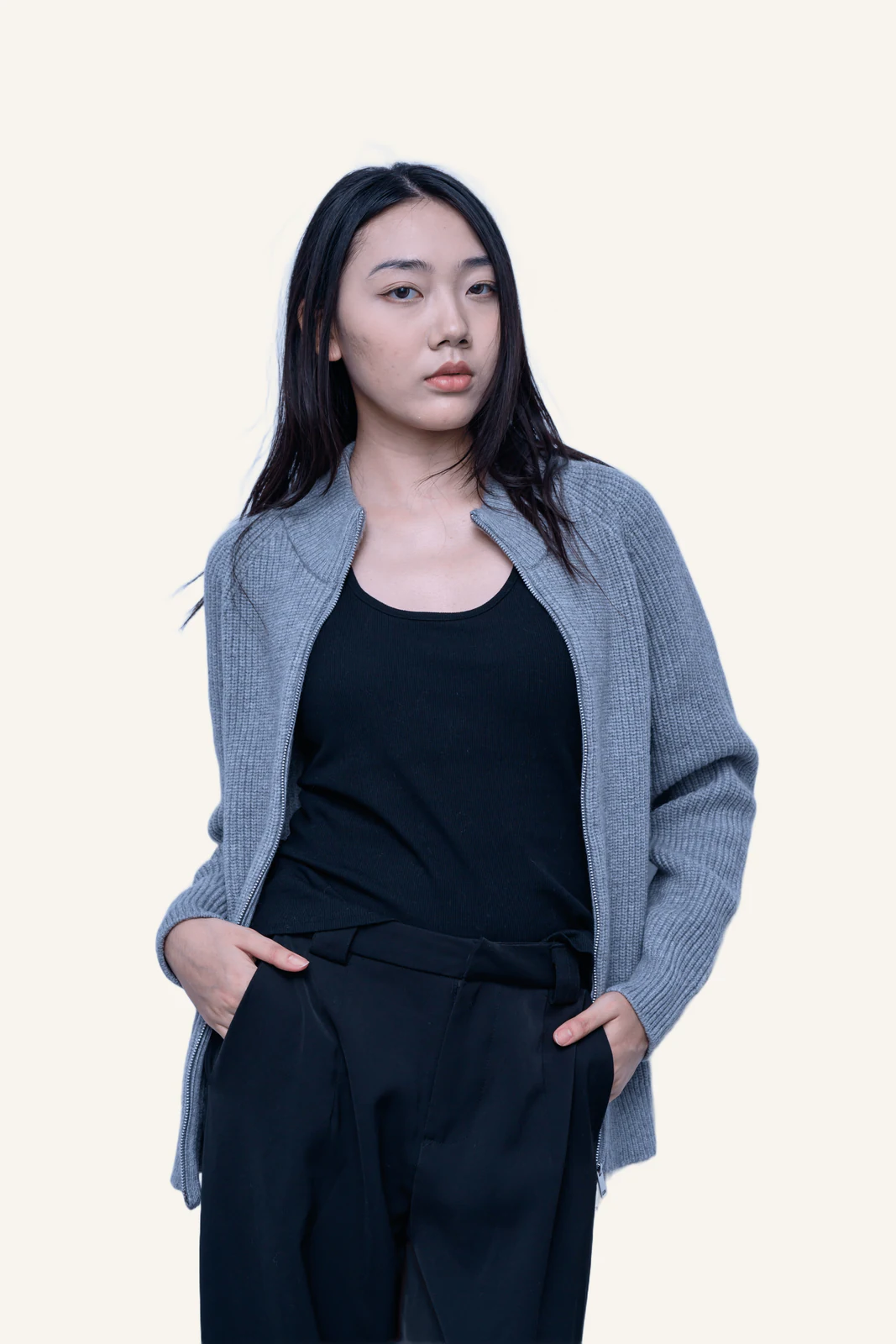
Vertical rib knit is a fabric structure in which alternating columns of knit and purl stitches create raised ridges running lengthwise. The supplied product description for the s043Misty Gray Vertical Rib Stand Collar Zip-Up Knit states that the full-body vertical ribbed texture enhances fabric structure and elasticity and resists deformation. That claim is consistent with how rib structures work: the purl columns pull the face stitches closer together, giving the fabric lateral stretch and recovery that a plain jersey lacks.
Mechanism and measurable variables
- Rib width and gauge: Wider ribs read as a bolder texture; finer ribs sit flatter and recover more subtly. Specify rib width in millimeters and stitch gauge (needles per inch) so the mill and factory quote the same structure.
- Stretch and recovery: Request elongation at a defined load and recovery after cycling. A rib that stretches easily but does not return will bag at the elbows and hem.
- Course vs. wale direction: Vertical ribs run along the wale direction. If panels are cut off-grain, the ribs skew after washing. Ask how panels are aligned before cutting.
- Zip insertion: A full zip in a stretch rib needs a stable tape or facing so the zipper does not wave. The stand collar and zip are described as allowing adjustable neck coverage, which depends on the zip running cleanly to the collar top.
Fit variables: drop shoulder and cropped length
The supplied description notes a relaxed drop-shoulder design and a cropped length intended to pair with high-waisted bottoms. In production terms, drop shoulder shifts the armhole seam down the arm, which changes how the sleeve hangs and how the underarm gusset (if any) is shaped. For QC, measure shoulder-to-shoulder at the seam, sleeve length from the dropped seam, and body length from high point shoulder. Cropped lengths are less forgiving of shrinkage, so wash-test shrinkage matters more than on a tunic-length style.
Inspection points for a rib zip-up
- Rib columns straight and continuous across side seams; no mismatched rib alignment at the join.
- Zipper tape flat, no puckering; slider moves without catching at the collar curve.
- Collar stands evenly on both sides when zipped to the top.
- Hem and cuffs recover after stretching; no permanent wave.
- Shade consistency across panels, especially on low-saturation colors like misty gray, where lot-to-lot variation is easier to see.
Textured ruffle collar cardigan: where detail drives cost and risk
The Cream Yellow Textured Ruffle Collar Knit Cardigan combines several detail elements in one garment: a ruffled stand collar, a wheat ear lace knit texture on the front placket, puff sleeves, and a cropped body. Each element is a separate construction decision, and each adds a failure point that a plain cardigan does not have.
Stitch and trim mechanics
The supplied description refers to a wheat ear lace knit texture on the front placket. Lace-like textures rely on planned yarn-overs or dropped-stitch effects to create openwork, which means the placket area has different stretch and stability than the body. Two practical consequences follow. First, the placket may need a backing or interfacing to hold buttons and buttonholes without distorting the openwork. Second, the openwork pattern must be mirrored left and right, or the cardigan will look asymmetric when worn open.
The ruffled stand collar is a gathered or pleated trim attached to a neckband. Its quality depends on gather ratio consistency, trim width, and how the ruffle is secured so it does not twist. Puff sleeves are shaped by extra fullness at the sleeve head, controlled by gathers or pleats; uneven gathering shows immediately as a lumpy shoulder line.
Color and lot control for cream yellow
Soft cream yellow is a low-chroma, high-lightness color. In knitwear, that combination tends to reveal lot variation, yarn contamination, and yellowing more than mid-tone colors. Buyers should specify a color standard (for example, a physical swatch or a numeric color reference agreed with the mill) and require lot approval before bulk. The supplied description positions the style for spring-summer transitions and autumn-winter layering, so the same color may be produced across seasons; confirm that the color standard is carried forward between orders.
Inspection points for a ruffle collar cardigan
- Ruffle attachment: even gather density, no twisted trim, collar stands symmetrically.
- Placket openwork: pattern continuous and mirrored; buttonholes clean and reinforced.
- Puff sleeve head: gathers distributed evenly, no puckers at the armhole seam.
- Cropped hem: level front and back; side seams straight.
- Hand feel and drape: the supplied description calls for a soft, skin-friendly knit that balances breathability and drape; agree a tactile reference swatch so "soft" is a measurable standard, not an opinion.
Cable knit four-piece winter set: consistency across matched pieces
A four-piece winter set raises a different problem from a single garment: matching. Cable knit patterns are three-dimensional, and the height and width of a cable depend on stitch count, yarn thickness, and tension. When the same cable motif appears on a hat, scarf, top, and bottom, any tension difference between machines or operators becomes visible as a scale mismatch.
What to specify for cable consistency
- Cable chart: A written stitch chart with stitch counts and crossing frequency, not just a photo.
- Gauge and tension: Agreed stitches and rows per 10 cm, checked on finished pieces, not only on swatches.
- Yarn lot: All four pieces from the same yarn lot where possible; if not, approve each lot against the color standard.
- Piece-to-piece scale: Cable width on the smallest piece should read at the same scale as on the largest, or the set will look assembled rather than designed.
Seasonal color and stripe alignment
The Christmas stripe cable knit set introduces stripe alignment as an additional variable. On circular or paneled knits, stripes must align at seams and at any change of knitting direction. Ask for a seam-alignment standard and inspect at the side seam, sleeve join, and any center-front join. For seasonal programs, also confirm that the stripe sequence is documented so repeat orders match the first production run.
Comparison table: construction variables by style
| Variable | Vertical rib zip-up | Ruffle collar cardigan | Cable knit winter set |
|---|---|---|---|
| Primary structural risk | Rib skew and zipper wave | Openwork distortion at placket; ruffle twist | Cable scale mismatch across pieces |
| Key measurement | Rib width, stretch/recovery, body length | Gather ratio, placket width, sleeve head fullness | Stitch/row gauge per 10 cm, cable width |
| Fit variable to confirm | Drop shoulder position; cropped length vs. shrinkage | Puff sleeve volume; cropped hem level | Piece-to-piece proportion and stripe alignment |
| Color risk | Low-saturation gray lot variation | Cream yellow lot variation and yellowing | Seasonal stripe color consistency |
| Inspection focus | Zipper function, collar symmetry, rib recovery | Ruffle attachment, mirrored openwork, buttonholes | Seam stripe match, cable tension, yarn lot |
Buyer checklist: questions that expose construction risk
Before approving a sample, ask questions whose answers can be verified on the garment. Vague answers are a warning sign in themselves.
- Can you provide a stitch chart or structure specification for the rib, openwork, or cable motif?
- What is the agreed gauge and how is it checked on finished pieces?
- How are panels aligned before cutting to prevent rib or cable skew?
- What color standard is used, and how are lots approved?
- What wash test is performed, and what shrinkage limits apply to cropped lengths?
- For the set, are all pieces knitted from the same yarn lot, and how is stripe alignment controlled at seams?
These questions connect directly to purchasing decisions: a supplier who can document structure and inspection reduces the risk of a bulk order that fails after the first wash. A supplier who cannot should be treated as unverified for that construction.
Limitations and what this guide does not cover
This article describes construction logic and inspection points. It does not provide fiber composition, yarn counts, machine gauges, or performance test results for the referenced styles, because those details are not supplied. Buyers should obtain them from the supplier's technical documentation and verify them against physical samples. Standards and test methods vary by market and buyer; specify the applicable standard in the tech pack rather than assuming a default.