August 14, 2026
The Best Fabrics for Woven Tops: Cotton, Linen, Silk & More
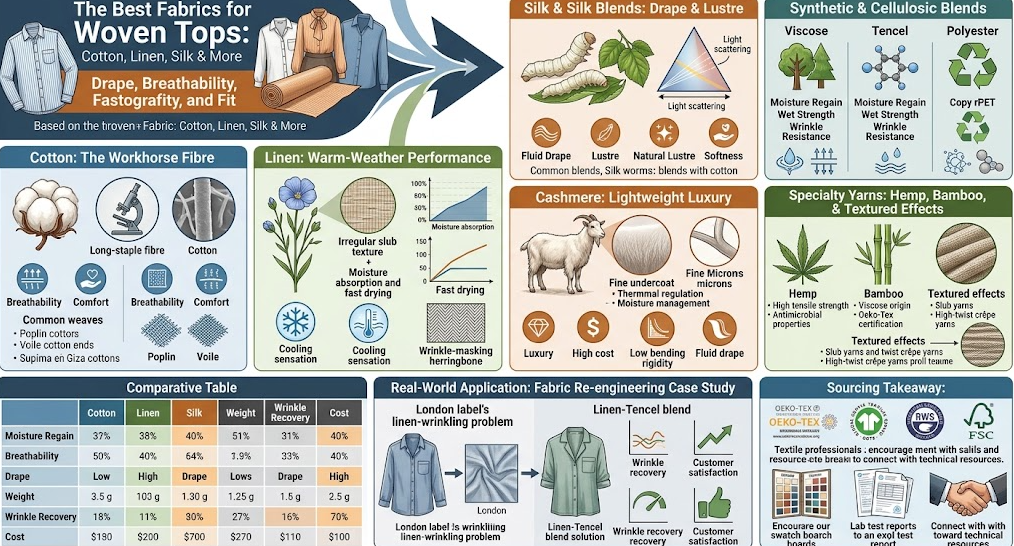
Choosing the right fabric for a woven top is rarely a simple aesthetic decision. It determines how the garment drapes, breathes, withstands repeated laundering, and fits into a brand’s price architecture. For sourcing managers, product developers, and textile buyers, the conversation starts with fibre composition, yarn structure, and weave construction. A summer blouse in 100% cotton poplin performs differently from one in a silk-linen blend, and a merino wool woven shirt behaves nothing like a viscose crepe.
This article examines eight fabric categories that dominate the woven tops market—cotton, linen, silk and silk blends, wool (including merino), cashmere, synthetic and cellulosic blends, and specialty yarns. Each section covers fibre characteristics, practical benefits, trade-offs, and typical end uses. Data points and case references are drawn from textile science literature, international testing standards, and publicly reported brand experience.
Table of Contents
What Makes a Fabric Suitable for Woven Tops
Cotton: The Workhorse Fibre
Linen: Warm-Weather Performance
Silk and Silk Blends: Drape and Lustre
Wool and Merino Wool: Beyond Knitwear
Cashmere: Lightweight Luxury in Woven Form
Synthetic and Cellulosic Blends: Viscose, Tencel, Polyester
Specialty Yarns: Hemp, Bamboo, and Textured Effects
Comparative Table: Key Properties at a Glance
Real-World Application: A Brand’s Fabric Re-engineering
Frequently Asked Questions
Sourcing Takeaway
1. What Makes a Fabric Suitable for Woven Tops
Woven tops—shirts, blouses, tunics, and lightweight overshirts—demand a specific set of textile properties. The fabric must be supple enough to fall gracefully yet have sufficient body to hold a collar or cuff shape. Breathability, moisture management, and skin comfort are non-negotiable for garments worn directly against the skin. From a manufacturing standpoint, the material should also exhibit acceptable shrinkage, seam slippage resistance, and colourfastness to washing and light.
Textile laboratories routinely assess these parameters using standards such as ASTM D3776 for fabric mass per unit area, ISO 15487 for appearance after domestic washing, and AATCC TM15 for colourfastness to perspiration. A fabric that passes these benchmarks can still fail commercially if the handle is wrong—proof that both objective data and subjective assessment matter when selecting woven top fabrics.
2. Cotton: The Workhorse Fibre
Cotton remains the most widely consumed natural fibre in apparel. For woven tops, the choice often falls on long-staple varieties such as Supima or Giza 87, whose fibre length exceeds 34 mm, producing smoother and stronger yarns. Standard upland cotton, typically 26–28 mm, is economical but more prone to pilling and surface hairiness in a tight poplin or voile weave.
Breathability and comfort. Cotton’s moisture regain hovers around 8.5% under standard conditions (65% RH, 20 °C), meaning it can absorb perspiration without feeling clammy at first contact. This makes cotton shirting a go-to for year-round use, although its thermal insulation is limited compared to wool.
Common weaves and finishes. Poplin, voile, oxford, and pinpoint are standard cotton weaves for tops. A compact-spun poplin at 120 g/m² delivers a clean, crisp hand ideal for formal blouses. Enzyme-washed cotton twill adds softness for casual overshirts. Anti-wrinkle finishes such as resin treatments can improve easy-care performance, though they may reduce tensile strength by 10–15% according to a 2018 study in the Journal of The Textile Institute.
Drawbacks. Pure cotton creases readily and loses strength when wet. For export markets, buyers often specify a maximum shrinkage of 3% in warp and weft, achievable through compressive shrinking or liquid ammonia treatment. Cotton also ignites at approximately 360 °C; while not a flame-retardant fibre, it chars rather than melts, which is a safety advantage over thermoplastics.
3. Linen: Warm-Weather Performance
Linen is extracted from the bast of the flax plant. Its fibres are 20–40 cm long, hollow, and have a natural irregularity that gives linen woven tops their characteristic slub texture. At 12% moisture regain, linen absorbs more water than cotton and desorbs it faster, creating a distinct cooling sensation on the skin.
Thermal and moisture behaviour. A 2019 thermal manikin study from the International Journal of Biometeorology measured the evaporative resistance of linen fabric at roughly 40% lower than that of an equivalent-weight cotton poplin. In practical terms, a linen tunic allows sweat to evaporate more freely, making it one of the best fabrics for woven tops in humid climates.
Wrinkle propensity. The downside is low elasticity—pure linen creases deeply, which some consumers accept as part of the fibre’s aesthetic. Blending linen with cotton or a small percentage of elastane (2–3%) reduces rigid creasing while retaining breathability. Textured weaves such as herringbone or honeycomb also mask wrinkles effectively.
Processing considerations. Linen yarn’s low elongation at break (approximately 2–3%) demands gentler loom tension settings. Sourcing managers often note that high-quality European flax, particularly from Belgium and Normandy, commands a premium but yields a finer, cleaner yarn with fewer shives.
4. Silk and Silk Blends: Drape and Lustre
Mulberry silk filament is triangular in cross-section, which scatters light and produces a natural lustre unmatched by synthetic fibres. Woven silk tops—crepe de chine, charmeuse, georgette—are valued for their fluid drape and soft hand. Silk has a moisture regain of about 11%, similar to linen, yet feels dry to the touch because of its smooth surface.
Blends and affordability. Pure silk is costly and requires delicate care. Blending silk with cotton, lyocell, or a small amount of wool creates fabrics that retain much of silk’s drape while improving durability and lowering wholesale price. Silk-cotton blends at a 30/70 ratio are common in mid-market blouses, delivering a subtle sheen and a machine-washable label.
Regulatory and sourcing notes. Silk imports into the EU and the US must comply with CITES if wild silk species are involved, though cultivated mulberry silk (Bombyx mori) is exempt. Buyers should verify the denier and twist of silk yarns; 16–20 denier filament yarns with 150–200 twists per metre produce a soft, crinkle-resistant woven fabric suitable for tops.
5. Wool and Merino Wool: Beyond Knitwear
Wool is often associated with knitwear, but fine merino wool fabrics weighing 150–200 g/m² make exceptional woven tops, particularly for transitional weather. Merino fibres average 18.5–19.5 microns in diameter, far finer than generic crossbred wool (25+ microns), which eliminates the prickle sensation on skin. The fibre’s natural crimp imparts bulk without weight, trapping air for insulation.
Thermal regulation. The hydrophilic core of wool absorbs up to 35% of its dry weight in moisture before feeling wet, while the hydrophobic outer cuticle repels light rain. A 2020 report by Australian Wool Innovation highlighted that a 100% merino woven shirting fabric maintained a microclimate temperature roughly 1.5 °C lower than a polyester-cotton equivalent during moderate exercise, reducing perceived heat stress.
Processing and care. Wool tops require anti-felting treatments if marketed as machine-washable. Chlorine-Hercosett and silicone-based treatments are common, though chlorine-free enzymatic processes are gaining traction due to environmental regulations. Fabric shrinkage must be kept below 3% after three wash cycles per IWS TM31.
6. Cashmere: Lightweight Luxury in Woven Form
Cashmere fibres, typically 14–18.5 microns, are harvested from the undercoat of cashmere goats. In woven form, cashmere appears in ultra-lightweight scarves, stoles, and luxury tops. The fabric’s low bending rigidity—averaging 0.8–1.2 mg·cm for a 100 g/m² cloth—translates into a fluid, almost liquid drape.
Why it stays a niche product. The global cashmere supply is constrained; approximately 25,000 tonnes of raw cashmere are produced annually, of which China contributes over 70% (FAO, 2022). Price volatility is high, and the fibre’s short staple length (28–42 mm) requires careful blending or special spinning techniques for warp yarns. Most cashmere woven tops are blended with silk, extra-fine merino, or lyocell to improve tensile strength and manage cost.
Sustainability lens. Overgrazing by cashmere goats has been linked to grassland degradation in Inner Mongolia. Brands increasingly specify the Good Cashmere Standard or Sustainable Fibre Alliance certification when sourcing.
7. Synthetic and Cellulosic Blends: Viscose, Tencel, Polyester
Synthetic and regenerated cellulosic fibres dominate the volume end of the woven tops market.
Viscose rayon offers a silk-like hand at a fraction of the cost. Its moisture regain reaches 13%, exceeding cotton, but wet strength drops by 40–50%, making delicate washing essential. Lyocell (Tencel™) solves this with a closed-loop production process and dry-wet strength retention of 85%, as documented by Lenzing AG’s technical datasheets.
Polyester microfiber woven tops provide dimensional stability, wrinkle resistance, and quick drying. When spun as 0.5–0.7 denier microfibre and woven into a peach-skin finish, the fabric becomes soft enough for next-to-skin use. A 2021 life-cycle assessment in Environmental Science & Technology showed that recycled polyester (rPET) reduces energy consumption by 45% compared to virgin polyester, a point now routinely featured in brand sustainability claims.
Blending strategies. Polyester-cotton (PC) blends, typically 65/35 or 50/50, combine cotton’s comfort with polyester’s strength. For drape-oriented women’s tops, viscose-nylon blends at 80/20 deliver a fluid silhouette while resisting seam slippage better than pure viscose.
8. Specialty Yarns: Hemp, Bamboo, and Textured Effects
The “specialty” category encompasses fibres and yarn techniques that add differentiation.
Hemp is a bast fibre with high tensile strength (approximately 55–65 cN/tex) and strong antimicrobial properties due to inherent cannabinoid-related compounds. Hemp woven tops start stiff but soften with wear, similar to linen. The European Industrial Hemp Association estimates that hemp cultivation uses 50% less water than cotton.
Bamboo in textile form is predominantly viscose made from bamboo pulp; mechanically produced bamboo linen exists but remains niche. Bamboo viscose woven tops are silky and thermo-regulating, though the chemical processing must follow the Oeko-Tex or bluesign® protocols to reassure environmentally conscious buyers.
Textured yarns. Slub yarns, mouliné (twisted two-colour) yarns, and crêpe twists introduce surface interest without printing. A crêpe woven top fabric achieves its pebbly texture through highly twisted weft yarns (up to 2,500 TPM) that retract during wet finishing. Such effects are valuable for brands looking to differentiate their collections without complex garment dyeing.
9. Comparative Table: Key Properties at a Glance
Fibre / Fabric | Moisture Regain (%) | Breathability | Drape Rating (1–5, 5=fluid) | Typical Woven Top Weight (g/m²) | Wrinkle Recovery | Relative Raw Material Cost |
Cotton (poplin) | 8.5 | High | 3 | 100–140 | Low | $ |
Linen | 12.0 | Very high | 2 | 120–180 | Very low | $$ |
Silk (crepe de chine) | 11.0 | High | 5 | 50–90 | Medium | $$$$ |
Merino wool (tropical) | 15.0–17.0 | High | 4 | 130–200 | Medium-high | $$$ |
Cashmere (lightweight) | 14.0 | Medium | 5 | 80–120 | Medium | $$$$$ |
Viscose (woven) | 13.0 | Medium-high | 5 | 90–140 | Low | $–$$ |
Tencel™ Lyocell | 12.5 | High | 5 | 100–160 | Medium | $$ |
Polyester microfiber | 0.4 | Low (unless textured) | 4 | 80–120 | High | $ |
Hemp (washed) | 12.0 | Very high | 2 | 140–200 | Very low | $$ |
Cashmere-silk blend (70/30) | 13.0 | Medium-high | 5 | 70–100 | Medium | $$$$ |
Data sources: textile manuals (Collier & Tortora, 2016); fibre specifications from Lenzing AG, AWI; cost indices from ITMF, 2023.
10. Real-World Application: A Brand’s Fabric Re-engineering
In 2019, a London-based contemporary womenswear label known for its woven blouses faced a recurring quality complaint: the pure linen tops sold well in June but generated returns due to “excessive wrinkling” by July. The brand’s product team worked with a Portuguese mill to develop a linen-Tencel blend (55% linen, 45% Tencel) with a subtly brushed reverse side.
The result, as documented in a case study published by the mill on its website (2021), was a fabric that retained linen’s dry touch and thermal comfort while reducing wrinkle severity by 42% as measured by the AATCC TM128 wrinkle recovery method. The top weight of 145 g/m² allowed a relaxed fit without adding bulk. Retail sell-through improved, and return rates for the woven top category fell from 11% to 4% within two seasons. The fabric is now a core carry-over quality for the brand’s spring-summer collection.
This case illustrates a larger trend: single-fibre fabrics are increasingly replaced by engineered blends that address specific consumer pain points while keeping the natural fibre story intact.
11. Frequently Asked Questions
Which woven fabric is best for year-round tops?
Cotton poplin and lightweight merino wool both work well across seasons. Cotton is more affordable and easier to launder; merino provides superior thermal regulation for travel and office-to-outdoor transitions.
How do I choose between silk and viscose for a drapey blouse?
Silk offers unmatched lustre, strength, and natural moisture management but comes at a higher cost and requires gentle care. Viscose closely mimics silk’s drape and is machine washable in many cases, though it loses strength when wet. For brands targeting the mid-market, a silk-viscose blend often strikes the right balance.
Can I use cashmere in a woven top for spring-summer?
Cashmere woven fabrics below 100 g/m² are suitable for cool summer evenings and air-conditioned environments. Blending cashmere with silk or lyocell extends the usable season and lowers wholesale price.
What certifications should I look for when sourcing these fabrics?
OEKO-TEX Standard 100 ensures the fabric is free from harmful substances. GOTS applies to organic cotton and linen. For wool, the Responsible Wool Standard (RWS) is widely accepted; for cellulosic fibres, FSC or PEFC certification ensures responsible forestry inputs.
How do I control shrinkage in woven tops made from natural fibres?
Pre-shrinking the fabric through compressive shrinking (Sanforized) or applying liquid ammonia treatment can reduce residual shrinkage to below 2%. Always request a test report per AATCC TM135.
12. Sourcing Takeaway
Selecting the best fabrics for woven tops is not about picking one winner. It is about aligning fibre performance, weave structure, and finish with the target consumer’s lifestyle and the brand’s supply chain realities. Cotton and linen dominate warm-weather basics. Silk, merino wool, and cashmere open doors to elevated price points. Blends—whether Tencel-cotton or silk-wool—offer a path to unique hand feel and lower return rates when engineered thoughtfully.
For buyers and product developers evaluating their next woven top collection, early engagement with mills on blend ratios, finishing options, and compliance documentation pays dividends in both product quality and speed to market. If your sourcing team is exploring new fabric qualities—from organic cotton voile to recycled polyester blends—our technical resource library includes recent mill audits, shrinkage benchmarks, and lab test reports that can sharpen your specification documents. Reach out to discuss how we can support your woven fabric development.