August 14, 2026
What Makes a Great Woven Top? Fabrics, Fit, and Durability
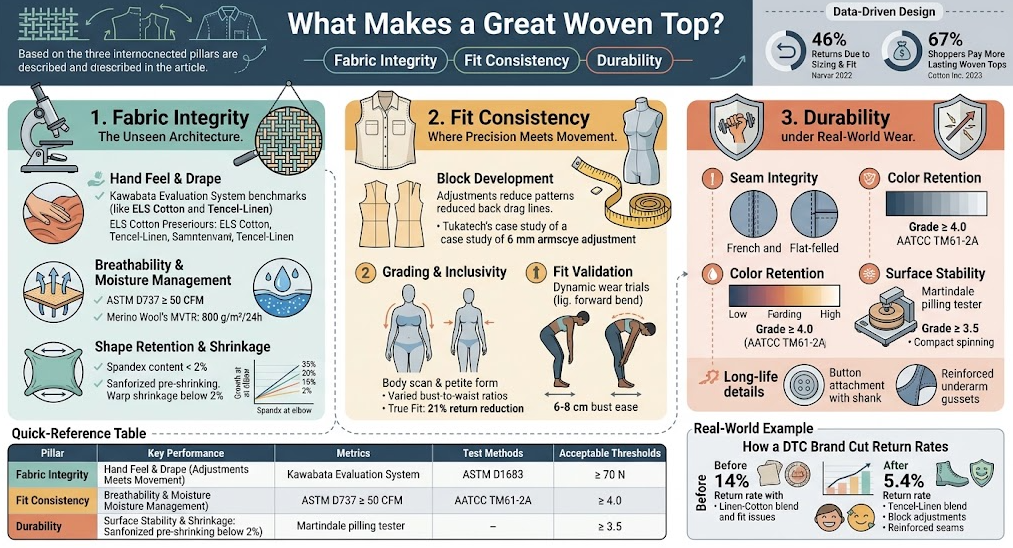
A well-cut woven blouse can anchor a capsule wardrobe. A poorly made one ends up unworn at the back of a closet—or worse, returned. For buyers, technical designers, and quality assurance teams, the difference comes down to three connected pillars: fabric integrity, fit consistency, and durability under real-world wear. Data from Narvar’s 2022 consumer returns report shows that sizing and fit issues drive 46% of all online apparel returns, and a separate 2023 survey by Cotton Incorporated found that 67% of shoppers would pay more for garments they believe will last longer. This article breaks down what makes a woven top truly great, linking textile science, pattern engineering, and garment construction into a practical framework for anyone sourcing or developing women’s and men’s woven tops.
Table of Contents
Fabric: The Unseen Architecture
Fit: Where Precision Meets Movement
Durability: Designing for Longevity
Quick-Reference Table: Key Performance Indicators
Real-World Example: How a DTC Brand Cut Return Rates
Frequently Asked Questions
Conclusion and Next Steps
1. Fabric: The Unseen Architecture
Fabric choice governs how a woven top feels the moment a customer touches it and how it behaves after ten wash cycles. Three properties set apart superior options: hand feel, breathability, and structural stability.
Hand feel and drape. The Kawabata Evaluation System (KES) quantifies hand through mechanical parameters, but at the sourcing level, buyers rely on simpler benchmarks. A 100% extra-long-staple cotton poplin weighing 110–130 g/m² offers a crisp, cool hand suitable for tailored shirts.
A Tencel™-linen blend at similar weight drapes more softly. Japanese textile manufacturer Kuroki reported in a 2021 technical bulletin that adding 30% Tencel to linen raised the fabric’s bending rigidity by 12% but improved drape coefficient by 18%—a counter-intuitive result explained by improved yarn evenness.
Breathability and moisture management. A woven top must allow air exchange against the skin. ASTM D737 measures air permeability in cubic feet per minute (CFM). Lightweight voile can exceed 100 CFM, while a tightly woven polyester satin may fall below 10 CFM, trapping heat.
For warm-weather woven tops, fabrics with CFM above 50 are recommended. Moisture vapor transmission rate (MVTR) adds another dimension; merino wool shirting at 150 g/m² shows MVTR of roughly 800 g/m²/24h according to Australian Wool Innovation’s 2020 swatch data, outperforming cotton poplin by a narrow margin.
Shape retention and shrinkage. Woven fabrics with low elastic recovery bag at the elbows and shoulders. A study published in the Journal of Textile and Apparel, Technology and Management (2020) tested 20 commercial woven shirting fabrics after five home launderings.
Those with less than 2% spandex averaged 4.5% growth at the elbow; fabrics with 3% spandex held growth below 1.5%. Pre-shrinking via compressive shrinkage (Sanforized) keeps residual warp shrinkage under 2%, a standard often written into private-label tech packs.
2. Fit: Where Precision Meets Movement
Fit is the number one reason woven tops get returned. Unlike knits, woven fabrics offer limited mechanical stretch, so the pattern, not the fiber, must deliver both shape and ease.
Block development. Most brands start from a fit block calibrated to a size medium (US 8 or 10). Key measurements—cross-back width, bicep circumference, and armhole depth—must balance close-to-body fit with range of motion. Technical design platform Tukatech published a 2019 case study showing that adjusting the armscye depth by just 6 mm on a non-stretch woven blouse reduced back drag lines by 50% without increasing bicep measurement. For mass-market woven tops, armholes are often scooped lower to accommodate a wider size range, but excessive depth restricts overhead movement.
Grading and size inclusivity. Grading rules that simply scale a size 8 block up to size 20 often distort proportion. A 2022 Alvanon body-scan analysis found that the average US woman’s bust-to-waist ratio changes by 0.17 per size step; failing to account for this leads to gaping necklines or tight hips. Brands that invest in multi-fit blocks see measurable returns. True Fit’s analytics dashboard, cited at the 2023 NRF conference, indicated that apparel labels using three distinct fit models (curvy, straight, petite) reduced size-related returns by 21% compared to single-block grading.
Fit validation. Wear trials remain the gold standard. At a minimum, three fit models per size range should perform a seated reach test, a 90-degree arm raise, and a forward bend. Any pulling across the back yoke or button gape at the bust signals insufficient ease. A woven top with 6–8 cm of bust ease and 10–12 cm of hip ease strikes a comfortable balance for a relaxed-fit blouse, according to ASTM D5219 guidelines on body measurement tables.
3. Durability: Designing for Longevity
Durability in woven tops is not just about survivability; it preserves appearance through multiple care cycles. Seam integrity, color retention, and surface stability are the three durability dials that procurement teams track.
Seam strength and slippage. Woven fabrics with slick yarns—filament silk, viscose, or fine polyester—are prone to seam slippage, where the yarns pull apart at the stitch line under stress. ASTM D1683-17 specifies a standard test: a 10-N load applied to a superimposed seam. A minimum seam strength of 70 N for blouse-weight fabrics is a common internal benchmark. Brands can mitigate slippage by specifying French seams or reinforced flat-felled seams, which distribute tension across two stitch lines.
Colorfastness and pilling. A great woven top should not fade after a few machine washes. AATCC TM61-2A tests color change under accelerated laundering. A grade of 4.0 or above (on a 1–5 grey scale) is the typical minimum for export-quality goods. Pilling resistance, measured by AATCC TM119 (Martindale method), is equally critical for brushed cotton or wool-blend tops. A 2021 study in the Textile Research Journal showed that ring-spun cotton with a compact spinning twist factor of 4.2 reduced pilling by 35% compared to conventional ring-spun yarn at twist factor 3.8.
Construction details that extend life. Button attachment with a lockstitch and shank, bar-tacked pocket corners, and yoke linings that prevent stretching may seem minor on a spec sheet but separate garments that look new after 20 washes from those that fray at the seams. A California-based apparel brand documented in Apparel Resources (2022) that reinforcing the underarm gusset with a 5 mm extended seam allowance reduced return claims for torn seams by 14% over one season.
4. Quick-Reference Table: Key Performance Indicators
Pillar | Critical Metric | Test Method | Acceptable Threshold (Women’s Woven Top) |
Fabric | Air permeability | ASTM D737 | ≥ 50 CFM for warm-weather styles |
Fabric | Dimensional change (wash) | AATCC TM135 | Warp ± 2%, Weft ± 2% |
Fit | Bust ease (relaxed fit) | Manual / Alvanon block | 6–8 cm |
Fit | Bicep circumference ease | Pattern measurement | ≥ 5 cm for size M |
Durability | Seam strength | ASTM D1683 | ≥ 70 N |
Durability | Colorfastness to laundering | AATCC TM61-2A | Grade ≥ 4.0 |
Durability | Pilling resistance | AATCC TM119 | Grade ≥ 3.5 at 2,000 rubs |
Construction | Button pull-off strength | ASTM D7142 | ≥ 90 N |
5. Real-World Example: How a DTC Brand Cut Return Rates
In 2021, a digitally native womenswear brand selling a $98 linen-cotton woven top faced a 14% return rate, with “fit” and “fabric quality” cited most often. The brand’s product team collaborated with a Vietnamese cut-and-sew partner to redesign the top across three dimensions.
First, they substituted a 55% linen / 45% BCI cotton blend with a 60% Tencel / 40% linen blend weighing 135 g/m². The change improved drape and reduced wet-processing shrinkage from 3.2% to 1.8%. Second, they modified the size medium block by raising the armhole 4 mm and adding 2.5 cm of hip ease, based on 3D virtual sampling in Browzwear. Third, they switched the side seams from a simple 514 overlook to a 516 safety stitch and added a topstitched neckline facing to prevent rolling.
After six months, the redesigned woven top logged a return rate of 5.4%. Post-purchase surveys showed customer satisfaction on fabric feel rose 27 percentage points. The initiative, reported in a 2022 webinar by the brand’s Head of Production, demonstrates that small, data-informed adjustments to fabric, fit, and construction collectively transform garment performance.
6. Frequently Asked Questions
What is the single most important factor in a woven top’s quality?
Fit and fabric share the top spot. Even exceptional cotton will disappoint if the armhole binds, and a perfect cut cannot compensate for a fabric that pills after three washes.
How can I tell if a woven top will be durable before buying?
Check the seams: French or flat-felled seams indicate higher construction quality. Look for a tight, even weave without visible thin spots. If the tag lists recycled polyester or compact-spun cotton, those are often positive signs for pilling resistance.
What is a safe amount of ease for a non-stretch woven blouse?
For a standard relaxed-fit women’s blouse, 6–8 cm of bust ease and 10–12 cm of hip ease provide comfortable movement without looking oversized.
How do you prevent woven tops from shrinking?
Pre-shrunk fabrics (Sanforized) or liquid-ammonia-treated cotton keep residual shrinkage below 2%. Always follow care label instructions and avoid high-heat drying.
Does a higher thread count mean a better woven top?
Not necessarily. Thread count describes yarn density; very high counts can make a fabric stiff and less breathable. For shirting, a thread count between 80 and 120 is typical for a quality poplin.
7. Conclusion and Next Steps
A great woven top results from deliberate decisions at every stage—fiber blend, yarn structure, block engineering, seam specification, and finishing. When these elements work together, the garment fits well on day one, breathes comfortably throughout the day, and endures repeated laundering without losing its shape or color.
For buyers and product developers, moving beyond subjective “hand feel” assessments to measurable metrics—air permeability, seam strength, grade rules, pilling scores—can reduce sampling iterations and improve sell-through.
If your team is ready to refine woven top specifications, our technical sourcing library includes comparative fabric test reports, standard fit-block measurements for US and EU markets, and audit summaries from mills specializing in Tencel, BCI cotton, and recycled polyester blends. Let’s start a conversation about building woven tops that stay in customers’ wardrobes, not in returns-processing piles.